
Art Crawl
Opening hours
Explore the Art at The Post
Take a self-guided journey through The Post and discover the art and artifacts that make this iconic building unique.
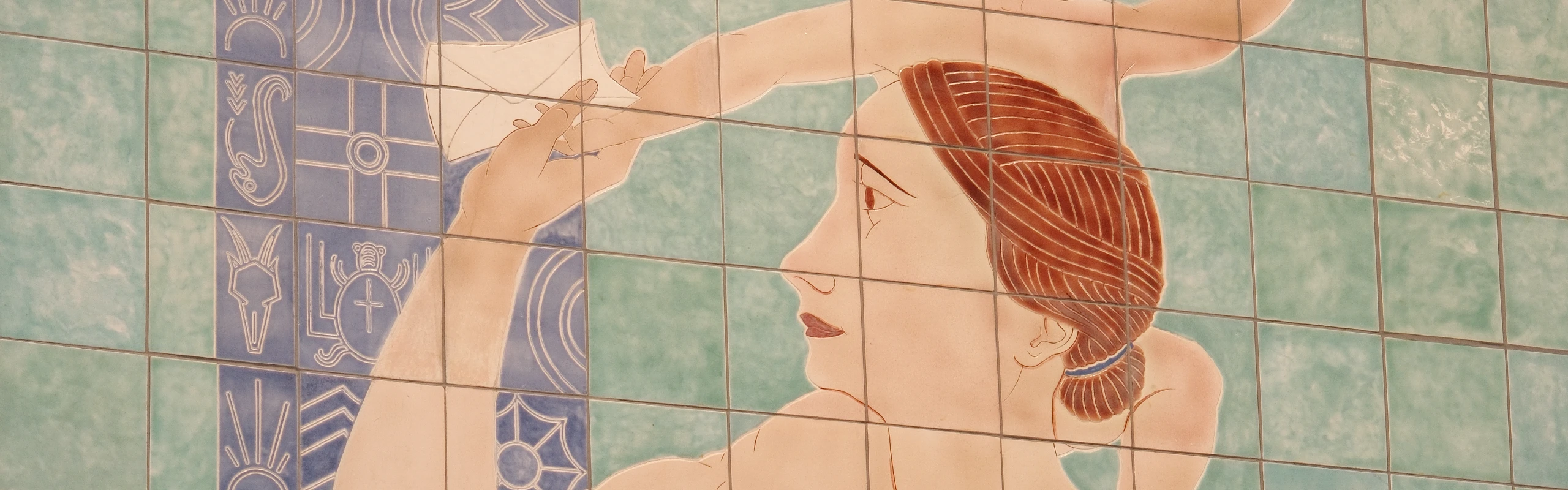
Mother and Child
Paul Huba
1958
Ceramic tile mural
The Mother and Child mural by Paul Huba originally dominated a staircase at the Hamilton Street end of the former public postal hall. The mural is made from hand-crafted tiles and is 5-metres (16 feet) tall. During the revitalization of this building, the entire mural was taken down and restored, tile by tile, and then remounted where you see it now. Hungarian-born Huba, who was also the sculptor behind The Postman bas-relief, arrived in Vancouver in 1954 after training in Austria and the UK. He was a strong advocate for the public art movement and using local materials wherever possible.
Painted Mural
Orville Fisher
1957
Painted mural
Orville Fisher was born in Vancouver in 1911 and studied under renowned Group of Seven painter Fred Varley. Before being commissioned to paint this mural for the former post office, Fisher was a war artist, and the only Allied artist to land with the troops on the beaches of Normandy in World War II. This mural from 1957 features Mercury, messenger to the gods, in gold in the centre and surrounded by depictions of the evolution of mail delivery in British Columbia. Can you spot the steam train, sailing ship, horse-drawn carriage and helicopter?
Time Capsule
1955
Copper box
Discovered behind the cornerstone — a slab of red granite weighing approximately four tonnes — was the copper time capsule you see today. Dedicated by The Honourable Robert H. Winter, Minister of Public Works on November 20, 1955, the time capsule was sealed behind the cornerstone of the former Post Office until it’s secrets were finally revealed by a team from the Museum of Vancouver on April 24, 2023. Included in the historic cache was a newly minted coin set from 1955, a penny (which Canada hasn’t made since 2013), stamps in various denominations, historical photos of Vancouver, and three local newspapers dated November 28, 1955.
Find out what else was discovered inside the time capsule, here.
Coats of Arms
Pearson Iron Works
1953-1958
Two cast-aluminum coats of arms
On the Georgia Street frontage of The Post, you will see the Arms of Canada, two Canadian coats of arms. These emblems are made from cast aluminum and stand 5.8-metres (19 feet) tall. After 1867, Canada’s coat of arms evolved as more provinces joined Confederation, and what you see here is the latest iteration, based on a design that was adopted in 1921 and proclaimed by King George V. If you look closely, you will see the arms of England, Scotland, Ireland and France, with Canadian touches, such as maple leaves at the bottom of the shield and in the paw of the lion at the top of the crest. To the left of the shield is a lion holding the Union Jack and to the right a unicorn holding the ancient banner of France.
The Postman
Paul Huba
1956
Carved granite bas relief
Paul Huba’s 4.9-metre (16 foot) bas-relief, carved from Swedish red granite, was installed in 1956, before the new post office opened in 1958. As part of the heritage redevelopment, it had to be moved by specialized forklifts and cranes to protect it from damage during construction. It was later reinstalled in this location where it’s more visible to the public.
Aristocratic Restaurants
1960s
2501 Granville Street (at Broadway), Vancouver
MOV Catalogue: H998.5.1
The Aristocratic was Vancouver’s premier restaurant chain from the 1930s to the 1960s, with up to a dozen locations. This sign from the Broadway and Granville location features “Risty,” a dapper little man in a top hat and bow tie.
The Aristocratic was started by Frank Hunter in 1928. Hunter owned a bakery and sold hamburger buns to a diner across the street. Realizing he could make a better profit by selling the whole burger instead of just the buns, Hunter bought the diner and called it Aristocratic Hamburgers. The first Aristocratic was a drive-in diner at Kingsway and Fraser. The Broadway and Granville location was the fifth to open, in 1940. The neon sign, designed by artist and sign maker Laurence Hanson for Neon Products was erected in the early 1960s by Hank Oliver, who took over the chain in the late 1950s. The Broadway and Granville location was the last to close, in 1997.
A small replica of this sign hangs in the window of Indigo Books, currently at Broadway and Granville, in tribute to this iconic Vancouver neon sign.
Gordon McCaw, contemporary photographer and neon enthusiast, photographed the Aristocratic Restaurant sign in 1985.
American Hotel
1940s
928 Main Street, Vancouver
MOV Catalogue: H996.22.28
This sign was from the American Hotel at 928 Main Street, on the edge of Strathcona. Built in 1907 as the Clarendon Hotel, the building was renamed the American Hotel in 1921. Over the following decades, the hotel had its ups and downs, and after numerous changes, it rebranded once more as The American in 2016. In 2020, the Province, through BC Housing, purchased the 42-unit hotel for people who have been living in supportive housing and are ready to take the next step toward independent living. The American bar remains on the ground level.
The sign was mounted over the hotel bar’s rear entrance, off Station Street. At the time this sign was made, regulations governing licensed premises restricted the words “licensed premises” to no more than 2 inches in height. This sign was designed and manufactured by Neon Products Ltd.
Contemporary photographer Greg Girard, captured this sign, along with its reflection, in 1975.
Photo 01: American Hotel, 1975 Greg Girard, photographer Courtesy of Artist
Palm Ice Cream
1940s-1950s
A product of Palm Dairies, sold at shops across the Lower Mainland.
MOV Catalogue: H977.1015.12
Palm Dairy distributors throughout the Lower Mainland displayed the Palm Dairy logo in various forms of neon from large storefront signs to small countertop models. This double-sided sign would have hung from the front of a building.
Palm Dairies began as a creamery in Palmerston, Ontario in the late 1800s. They opened their first Vancouver manufacturing and distribution plant in 1929. Palm Dairies expanded in Vancouver and New Westminster by purchasing several smaller dairies, including Turner’s and Crystal Dairy. Dairyland purchased Palm Dairies in 1989.
Although many Palm signs were manufactured by Neon Products Ltd., this particular sign was made by Wallace Neon Ltd.
While there are historical photographs of Palm neon signs, MOV has not been able to locate one of this exact design.
Photo 01: Palm Ice Cream, 1953 Julius Shore, photographer Vancouver Public Library 82387A
Photo 02: Palm Ice Cream, 1945 Don Coltman, photographer City of Vancouver Archives, AM1545-S3-: CVA 586-15746
The Cookie Jar
1950s
A Vancouver bakery with multiple locations.
MOV Catalogue: H996.22.20
The Cookie Jar bakery first appeared in the 1936 City Directory on West Boulevard in Kerrisdale and moved around the corner to West 41st in 1941.
The company began opening additional locations in 1950, and by the 1960s and 70s, approximately half a dozen Cookie Jar bakeries were in operation, including in the West End and West Vancouver. By 1985, however, there were just two locations remaining, one at 583 Granville and the flagship store at 2145 West 41st Ave. The latter Kerrisdale location was the last to close in 1989.
By the late 1960s, The Cookie Jar had updated its look opting for a new modern style of back-lit plastic signs.
This older style sign was designed and manufactured by Neon Products Ltd. A Cookie Jar neon sign matching this one is visible at the West 41st location in a photograph of the Miss Kerrisdale Pageant parade in 1958.
Photo 01: Cookie Jar, 1958 H.E. Addington, photographer City of Vancouver Archives, AM980-S1-: CVA 804-66
Photo 02: The Province, May 27, 1939, p. 67
“R” from the Ridge Theatre
1950
3131 Arbutus Street, Vancouver
MOV Catalogue: H2016.2.1a
The Ridge Theatre opened at Arbutus and 16th Avenue in 1950 and closed in 2013. The site was redeveloped by Cressey Development Group which had the RIDGE sign replicated, at a somewhat smaller scale, and placed on top of the combination grocery and condo development that replaced the theatre and adjacent bowling alley.
The theatre was widely known for its repertory cinema and film festivals as well as for its being the only theatre with a crying room (for caregivers and babies). The demolition of the theatre and bowling alley was controversial as it represented the removal of community space in Vancouver.
Note the effective mix use of incandescent light bulbs and neon light in the design. And yes, the Museum of Vancouver has all five neon letters of the Ridge sign in its collection!
This sign was manufactured by Wallace Neon Ltd.
Photo 01: Ridge Theatre Opening, 1950, Artray photographer, Vancouver Public Library 81242A
Photo 02: Ridge Theatre Opening, 1950, Artray photographer, Vancouver Public Library 81242
Photo 03: Vancouver Sun, April 15, 1950, p. 39
Photo 04: Ridge Theatre, 1996, Gordon McCaw photographer, Courtesy of Artist
The Welding Shop
replica, 2021; original, c. 1930
1600 Main Street, Vancouver
MOV Catalogue: R 20; original sign: H996.22.21
This sign is a working replica of the neon sign for The Welding Shop and Engineering Co. Ltd. The original is too fragile to be rewired and lit, so Tops Lighting made this replica in 2021.
The Welding Shop was in business for over one hundred years from 1914 until 2018, with the neon sign itself dating from the period when the company was located at 1600 Main Street, between 1928 and 1974. The sign was once part of a larger rooftop display on the corner of the building which featured the welder with torch and sparks, and “The Welding Shop” in neon below. MOV is fortunate to also have the original plans in the collection. The sign was designed and manufactured by Neon Products Ltd.
On The Welding Shop’s 40th anniversary in 1954, The Province newspaper reported that “There’s hardly an industry in BC which has not been provided with service or fabrication work by The Welding Shop and Engineering Co.” In addition to these operations, The Welding Shop also offered instruction in welding at their Vancouver Welding School.
Photo 01: The Welding Shop, date unknown, Photographer unknown
Photo 02: The Province, Dec. 15, 1954, p.55
Photo 03: Vancouver Sun, Mar. 26, 1954, p. 38